Every plastic pipe line lives or dies on tension control. The extruder pushes soft, hot polymer out of the die; something downstream has to pull it away at exactly the right speed, hold it straight, and never crush or mark it. That job belongs to the haul-off machine — the caterpillar unit that sets the pace for the entire line.
Pull too fast and the pipe stretches, thinning the wall below spec. Pull too slow and the pipe sags and goes out of round. The haul-off is where dimensional accuracy is won or lost, which is why it is treated as a critical component rather than a passive conveyor.
What a Haul-Off Machine Actually Does
A haul-off (also called a caterpillar or puller) grips the extruded pipe between two or more motor-driven tracks and pulls it uniformly away from the extruder. Its three core functions are:
- Speed control — matching the pull rate to the extrusion rate so diameter and wall thickness stay consistent along the whole length.
- Tension control — maintaining constant, controlled pulling force so the pipe does not stretch or buckle.
- Grip without damage — holding the pipe firmly on rubber pads that do not mark or squash the surface.
For a deeper look at where this sits in the line, see our companion article on the role of the haul-off machine in downstream extrusion.
Track Count: Why 2, 4 or 6 Caterpillars Matters
The number of driven tracks scales with pipe diameter and the pulling force required. Smaller PVC lines run comfortably on a 2-track unit; large-diameter HDPE needs more contact area to grip without slipping, which is where 4- and 6-track configurations come in. The POWERPULL haul off machine series is built exactly around this principle — an energy-efficient, independently driven caterpillar with 2, 4 or 6 tracks and floating tracks that maintain grip and prevent slippage across the range.
POWERPULL range at a glance
- POWERPULL 125 — up to 125 mm OD, 2 caterpillars, ~35 m/min max speed.
- POWERPULL 250 — up to 250 mm OD, 4 caterpillars.
- POWERPULL 630 — up to 630 mm OD, 6 caterpillars for large-diameter lines.
Editorial: figures above are drawn from the POWERPULL technical specification table on the product page. Confirm current model list before publishing.
Key Engineering Features That Protect Pipe Quality
The features that separate a precision haul-off from a basic puller all trace back to one goal — constant force with zero surface damage:
- Vector motor + encoder — independently driven caterpillars deliver constant pulling power with precise, repeatable speed.
- Long caterpillar contact length — more grip area means reliable traction without over-clamping.
- Anti-squash pivoted upper tracks — a control device prevents crushing of thin-wall pipe.
- Motorised diameter positioning — tracks adjust to pipe OD quickly between runs.
- Natural rubber pads — anti-slip pads that grip any surface without leaving a mark.
Where the Haul-Off Sits in the Downstream Line
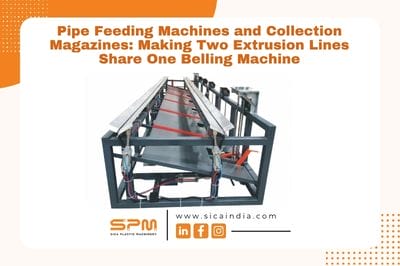
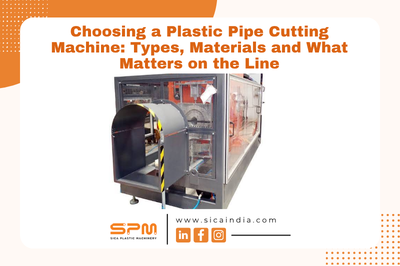
The haul-off is the pace-setter, but it works as part of an integrated finishing sequence. After the pipe is pulled and cooled, it moves to the cutting and chamfering station, then to the automatic belling machine for socketing. On dual extrusion lines, an AUTOFEED collection table feeds pipes one at a time into the belling station. Get the haul-off right and every station downstream inherits a straight, in-spec pipe.
See how the full sequence fits together on our downstream pipe extrusion equipment hub.
Choosing the Right Haul-Off for Your Line
Match the unit to three variables: maximum pipe OD, required line speed, and material. Rigid PVC needs firm, even grip; flexible HDPE at large diameters needs maximum contact area and pulling force. When those three are defined, the track count and model follow directly.
Planning a new line or upgrading an existing one? Talk to the SICA India team for a haul-off spec matched to your pipe range.