Chip Extraction and Dust Collection in Plastic Pipe Cutting: A Quality Problem, Not a Housekeeping One
Cutting debris on a pipe extrusion line is usually filed under housekeeping. It belongs under quality control. Chips that end up inside the pipe bore travel with the pipe into the belling machine, into the socket seat, and eventually into a joint where they damage a gasket or prevent a seal. By the time the failure is visible, the cause is three processes upstream and impossible to trace.
This article covers where cutting debris comes from, why the cutting technology you choose determines how much of it you generate, and how extraction systems are designed to capture it at source.
1. What cutting debris actually costs
Four distinct costs, only one of which is visible on the shop floor:
- Joint failure risk. Debris carried into a socket seat damages rubber gaskets and O-rings at assembly, or prevents full seating. The failure surfaces in the field.
- Rework and rejection. Pipes with visible internal debris are cleaned manually or rejected. Both consume labour that was supposed to be removed by automation.
- Machine wear. Accumulated dust in guideways, clamps and moving assemblies accelerates wear on the cutting carriage.
- Workplace environment. Airborne PVC dust settles across the line and creates a housekeeping load that scales with output.
The important point: the first two are quality costs, and they are the ones that do not appear in any maintenance budget.
2. Where the debris comes from -cutting technology decides
Plastic pipe cutting machines generate debris in proportion to how much material the cutting tool removes. Three approaches are used on planetary pipe cutting machines, and they behave very differently.
Disc cutting (D series)
A rotating disc removes a kerf of material as it cuts. Material removal means chips, and chips must be extracted. Disc systems are the standard approach for rigid PVC and are well suited to thick-walled pipe and to combined cutting and chamfering, because a milling cutter can form the chamfer in the same pass. Debris volume is highest here -which is why chip extraction is integral to the machine rather than optional.
Knife cutting (K series)
A planetary knife parts the pipe wall by displacement rather than removal. Applied to rigid PE and PP pipes, this cuts without producing chips and scraps at all. The debris problem is not managed -it is not created. The trade-off is material suitability: the knife approach is applied to PE and PP rather than to rigid PVC.
Combined cutting (DK series)
Two arms working in sequence. The first carries a cutting disc and/or milling cutter and cuts to a given depth; the second carries a knife only and completes the cut through the remaining wall thickness. Because the knife breaks through the inner wall, no chips get inside the pipe. This is the configuration that solves the bore contamination problem directly while retaining chamfering capability.
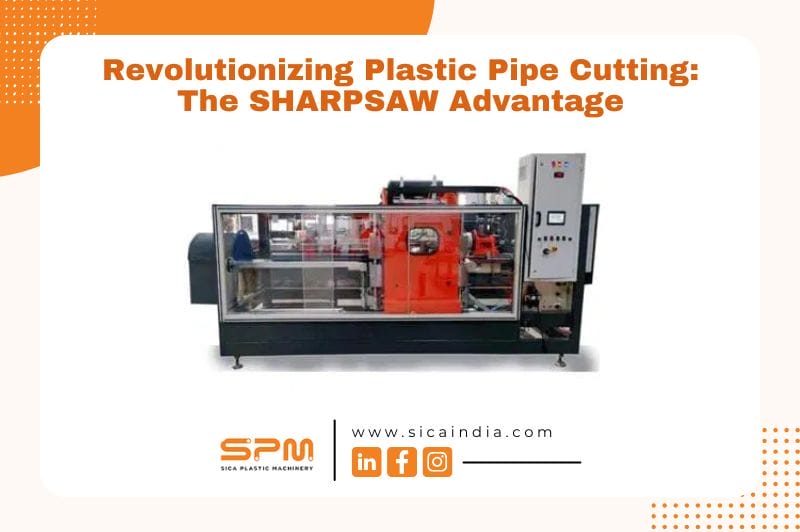
The SHARPSAW DK series covers this combined system in detail. Where the material is rigid PE or PP, the SHARPSAW 250K and 400K models feature swarfless cutting units -the SHARPSAW range lists the full model line-up.
3. Technology selection matrix
| Series | Cutting method | Suited to | Debris behaviour |
| D | Planetary disc, hydraulically driven arm with feeler pin | Rigid PVC, PE, PP -cutting and chamfering | Chips produced; chip extraction system fitted |
| K | Planetary knife | Rigid PE and PP | Cuts without production of chips and scraps |
| DK | Disc and/or milling cutter, then knife | Rigid PVC, PE, PP -combination cutting | No chips get inside the pipe; chip extraction fitted |
Note that the D and DK series both adjust chamfer depth automatically, and both use a hydraulically driven cutting arm with a feeler pin that handles thick-walled and out-of-round (oval) pipe. For a broader comparison of cutting approaches, see the four fundamental types of plastic pipe cutting machines and the SHARPSAW cutting advantage.
4. How a chip extraction and dust collection system is built
An extraction system on a pipe cutting machine has four elements, and weakness in any one makes the other three ineffective.
- Capture at source. The hood or shroud sits at the cutting rotor, where chips have velocity and direction. Debris that escapes the cutting zone is far harder to recover downstream.
- Conveying. Ducting must maintain sufficient air velocity to keep PVC chips entrained. Undersized or over-long duct runs allow material to drop out and block the line.
- Separation and filtration. Chips and fine dust separate differently. A system sized only for chips will pass fines back into the workshop air.
- Collection and disposal. Clean PVC chips are recyclable material. Contaminated chips are waste. Keeping the collection point clean determines which category your output falls into.
SHARPSAW D and DK series machines include a chip extraction system as part of the machine specification, and the D version is designed to operate with a dust collection system that keeps the working environment clean. Pneumatic and hydraulic systems provide the smooth operation the extraction hood needs to stay correctly positioned relative to the cutting rotor.
5. Material behaviour: PVC, HDPE, PPR and PP
Debris behaviour is material-specific, and a system sized for one material will not necessarily handle another.
| Material | Typical cutting approach | Debris characteristic |
| Rigid PVC | Disc, or disc plus knife (DK) | Brittle chips and fine dust; the strongest case for extraction |
| HDPE | Planetary knife (K) | Cut without chips and scraps; ductile material smears rather than powders under a disc |
| PPR | Planetary knife (K) | Cut without chips and scraps |
| PP | Knife, or combined DK | Ductile; knife cutting avoids the swarf a disc would produce |
SHARPSAW manages PVC, HDPE, PPR and PP. The D version uses a planetary disc rotary system with high-speed servo motors and pipe clamps for precise cutting of PVC and PP pipes; the K version uses a planetary knife system with high-speed motors and pipe clamps for HDPE and PPR. For HDPE line planning specifically, see the HDPE pipe extrusion line downstream guide.
6. Chamfering: the second debris source most plants forget
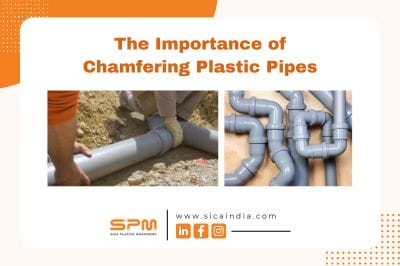
Chamfering removes material by definition. It is also non-negotiable -chamfering removes cutting burrs and shavings, leaving a clean surface so fittings seat properly, and it prevents sharp edges from damaging rubber gaskets and O-rings during assembly.
So the chamfer that solves one debris problem creates another. Where chamfering is performed inline on the cutter, the extraction hood must capture debris from both the cutting rotor and the chamfering tool. Where it is performed as a separate operation, the standalone unit needs its own capture.
On SHARPSAW D and DK machines chamfer depth is adjusted automatically as part of the cutting cycle. Where an external chamfer is required on the opposite side of the socket, CHAMFER 250 can be installed as a standalone unit with pneumatic and electric movement under PLC control. Further reading: the importance of chamfering plastic pipes, the ins and outs of cutting and chamfering, and the pipe chamfering machine buyer and working guide.
7. Operating and maintenance protocol
- Inspect the bore, not the floor. Visible floor debris is a housekeeping signal. Debris inside the pipe is a quality signal. Check finished pipe ends at every shift change.
- Check hood position after every tooling change. A hood displaced by a few millimetres from the cutting rotor loses most of its capture efficiency.
- Monitor duct runs for settlement. Falling extraction performance is usually accumulation in the ducting, not fan failure.
- Empty collection before it packs. A full collection point restricts airflow through the whole system.
- Keep recyclable chips segregated. Clean PVC chips have recovery value; mixed or contaminated chips do not.
- Keep guideways and clamps clean. Dust in the cutting carriage assembly accelerates wear and affects cut accuracy over time.
8. Frequently asked questions
How do I stop chips getting inside the pipe during cutting?
Use a cutting method that does not push material into the bore. In the combined DK system, the disc or milling cutter cuts to a set depth and a knife completes the cut through the remaining wall thickness, so no chips get inside the pipe. For rigid PE and PP, planetary knife cutting produces no chips or scraps at all. See the SHARPSAW DK series.
Does a dust collection system reduce cutting accuracy?
No. Extraction removes debris from the cutting zone, which if anything supports accuracy -accumulated debris around clamps and guideways is a known cause of drift. A dynamically balanced cutting rotor is what delivers accurate cutting with no rough edges at high speed.
Which pipe materials produce the most cutting debris?
Rigid PVC cut with a disc produces the highest volume of chips and fine dust, because a disc removes a kerf of material. Knife-based cutting of rigid PE and PP produces no chips and scraps.
Can chip extraction be retrofitted to an existing cutter?
It depends on the machine. Effective capture requires the hood to be positioned correctly relative to the cutting rotor, which is a design constraint rather than an accessory. Contact SICA India with your current cutter model to discuss options.
What pipe sizes does SHARPSAW cover?
SHARPSAW models run from small-diameter units up to OD 630 mm, across D, K and DK configurations, with carriage strokes from 300 mm to 2000 mm depending on model. Full specifications are on the SHARPSAW product page and the chamfering machine India page.