A socket is the only part of a plastic pipe that is manufactured twice. It is extruded once as plain pipe wall, then re-heated and re-formed at the belling machine into a geometry that has to seal for decades under pressure, ground load and thermal movement. That second forming step is where most field joint failures are actually born -long before the pipe reaches a trench.
This guide breaks down the eight socket defects that show up most often on Indian PVC, SWR and pressure pipe lines, traces each one back to a controllable process variable, and sets out a line-side QC protocol you can run without laboratory equipment.
1. Why socket geometry decides joint integrity
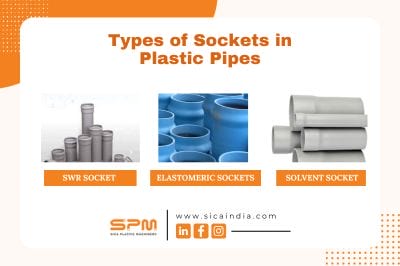
Every socket type carries its own failure mode. A solvent cement socket depends on a controlled interference fit -too loose and the cement gap is starved, too tight and the pipe cannot be inserted to full depth. An elastomeric or O-ring pressure socket depends on a precisely formed ring seat: the groove must hold the rubber ring square to the pipe axis under internal pressure. An SWR socket has to accept a ring while keeping the smooth bore that drainage flow requires.
If you are still deciding which socket profile suits your product mix, the breakdown of solvent cement, SWR and elastomeric socket types sets out where each is used. This article assumes the socket type is already fixed and focuses on making it dimensionally correct, repeatably.
The economic case is simple: a socket defect is discovered either by your QC team at a cost of one pipe, or by a contractor at a cost of an excavation, a replacement, and a customer relationship.
2. The eight defects that account for most socket rejects
| Defect | What you see | Primary root cause |
| Ovality at the bell mouth | Socket out-of-round; ring sits proud on one side | Uneven oven heating or pipe not rotated during heating |
| Short socket depth | Pipe bottoms out before full insertion | Mandrel stroke or stop setting drifted; feed misalignment |
| Wall thinning at the shoulder | Translucent or stretched band behind the bell | Over-heating, or forming attempted above the softening window |
| Ring groove out of tolerance | O-ring loose, rolls or extrudes under pressure | Worn collapsible mandrel or wrong tool for the socket type |
| Longitudinal stress marks | Whitened lines running back from the bell | Cooling cycle cut short; socket released while still hot |
| Non-perpendicular bell face | Socket not square to the pipe axis | Angled cut upstream, or pipe not clamped square during forming |
| Burrs and chips inside the socket | Debris in the seat; gasket damage at assembly | Cutting swarf carried into the belling machine on the pipe end |
| Socket shrink-back | Bell diameter reduces hours after production | Insufficient hold time; residual orientation stress not relieved |
3. Root cause one -heat input and oven control
More socket defects trace back to heating than to any other variable. PVC has a narrow forming window: below it the material will not flow into the mandrel profile and springs back; above it the wall thins, the socket sags, and residual stress locks in and releases later as shrink-back.
Three heating controls matter on production lines. First, temperature uniformity around the circumference -a pipe heated more on one side ovalises the moment the mandrel enters. Second, soak time versus surface temperature -thicker walls need heat to reach the core, not just scorch the skin. Third, a genuine cooling cycle that sets the geometry before the socket is released.
Dual-oven belling machines address the first two directly. The FASTFORM automatic inline belling machine uses a dual oven with pipe rotation during heating, plus defined heating and cooling cycles, so heat is distributed all around the pipe rather than on one face. Dual ovens are available on selected models -confirm configuration against the model you are specifying.
4. Root cause two -tooling and mandrel selection
The second largest source of defects is running the wrong tool for the socket being produced. Tooling is not interchangeable, and a worn mandrel will produce dimensionally drifting sockets long before it looks worn to the eye.
| Socket type | Tooling required | Typical defect if mismatched |
| Solvent cement socket | Plain socketing tool | Interference fit out of range; starved or over-thick cement gap |
| SWR socket | Socketing tool with outside mould (allows logo and diameter engraving) | Ring seat malformed; engraving illegible |
| SWR or elastomeric ring socket | Mechanical collapsible mandrel | Ring groove out of tolerance; ring extrudes under pressure |
FASTFORM 250 and FASTFORM 400 are multipurpose machines built to run all three tool families, with zero pipe wastage in continuous operation. The SWR socketing machine configuration covers the SWR-specific setup in more detail, and the BSC belling machine and MULTIFORM range cover alternative socketing formats. If you are still at the selection stage, the guide on how to choose a belling machine walks through the specification logic.
5. Root cause three -what arrives from upstream
A belling machine can only form what the cutter and haul-off hand it. Three upstream conditions cause socket defects that look like belling faults but are not:
• Out-of-square pipe ends. An angled cut produces a bell face that is not perpendicular to the pipe axis. No belling parameter corrects this.
• Un-chamfered or burred ends. Burrs and cutting debris carried into the mandrel become embedded in the socket seat, then cut the gasket at assembly.
• Pipe ovality from the haul-off. An oval pipe entering the oven exits as an oval socket.
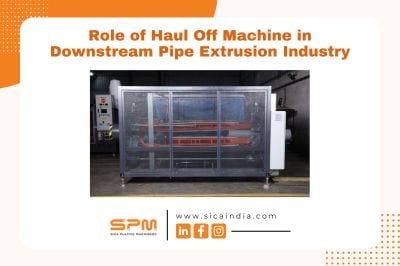
The SHARPSAW cutting and chamfering machine addresses the first two: a hydraulically driven cutting arm with a feeler pin handles thick-walled and out-of-round pipe, chamfer depth is adjusted automatically, and a chip extraction system keeps debris out of the pipe bore. For ovality control, pivoted upper caterpillars on the POWERPULL haul-off include an anti-squashing device, and natural rubber pads on the chain conveyors avoid marking the pipe surface. Background reading: the role of the haul-off machine in downstream extrusion and why chamfering plastic pipes matters.
6. Root cause four -cooling, release and post-forming handling
Sockets fail after the machine as often as inside it. A socket released before the cooling cycle completes will continue to move dimensionally for hours. Stacking hot socketed pipes under load compounds this: the weight of the stack deforms bells that have not yet set.
• Allow the full cooling cycle. Cutting it to gain line speed is the most expensive throughput decision on the line.
• Let finished pipes fall onto a tilt table or trolley rather than a hard floor. Link Channels -belt conveyors of 3.0 m or 6.0 m length for pipes from OD 32 mm to OD 250 mm, with inverter belt-speed adjustment -move socketed pipe away from the belling bench without impact.
• Do not stack socketed pipe warm. Route it through pipe handling and palletizing so bells are supported, not crushed.
Where rubber rings are inserted inline, the RINGFIT 160 ring insertion device seats the ring mechanically and consistently -worth noting because manual ring insertion into a warm socket is itself a source of groove damage. See also rubber ring insertion in SWR sockets.
7. A line-side QC protocol you can run today
None of the following requires laboratory instrumentation. Run it at every shift change, after every tooling change, and after any oven parameter adjustment.
1. Socket depth. Gauge insertion depth against your spec on two pipes per shift, per line. Log the value; drift matters more than a single reading.
2. Ovality check. Measure the bell internal diameter on two axes 90° apart. A widening gap between the two readings signals uneven heating before rejects appear.
3. Perpendicularity. Stand the socketed end on a flat plate. Visible rock indicates an upstream cutting problem, not a belling problem.
4. Ring seat function test. Fit a ring and confirm it seats square with uniform compression around the circumference.
5. Wall thickness at the shoulder. Check the transition zone behind the bell -this is where over-heating shows first.
6. Bore cleanliness. Visually inspect for chips and swarf. Any debris means the chip extraction on the cutter needs attention.
7. 24-hour shrink-back audit. Re-measure one socket from the previous day. Movement indicates the cooling cycle is too short.
8. Specifying a machine that prevents defects instead of sorting them
If your reject rate is structural rather than incidental, the fix is usually specification, not operator discipline. Four capabilities separate machines that hold tolerance from machines that need constant intervention:
• Dual oven with pipe rotation -removes circumferential heat variation, the root of ovality.
• Defined heating and cooling cycles under automatic control -removes operator judgement from the two variables that matter most.
• Multipurpose tooling capability -one machine covering solvent cement, SWR and elastomeric ring sockets prevents the mismatch failures in Section 4.
• Direct feed from the cutter -on FASTFORM 250 and 400, pipe is conveyed automatically from the cutter through the first oven, the second oven and then socketing, removing manual handling between cut and form.
| Model | Diameter range (mm) | Socket types | System |
| FASTFORM 90 | 16 – 90 | Solvent cement, SWR | Automatic multisocketing (hydraulic + pneumatic) |
| FASTFORM 110 | 26 – 110 | Solvent cement, SWR | Automatic multisocketing (hydraulic + pneumatic) |
| FASTFORM 250 | 50 – 250 | Solvent cement, SWR, elastomeric ring | Automatic (hydraulic + pneumatic) |
| FASTFORM 400 | 63 – 400 | Solvent cement, SWR, elastomeric ring | Automatic (hydraulic + pneumatic) |
| MULTIFORM 110 | 16 – 110 | Solvent cement, SWR | Automatic multisocketing (pneumatic) |
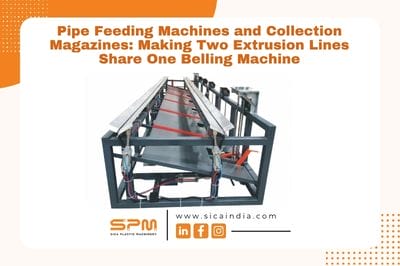
Full specifications, including the FASTFORM M200 semi-automatic models, are on the FASTFORM product page. For plants running two extruders into one belling machine, how FASTFORM handles dual extrusion lines covers the collection table configuration.
9. Frequently asked questions
What causes PVC pipe sockets to go oval?
Uneven heat distribution around the pipe circumference is the dominant cause. A pipe heated more on one face softens asymmetrically and deforms when the mandrel enters. Dual ovens with pipe rotation during heating address this directly. Pipe ovality arriving from the haul-off is the secondary cause.
Why do sockets shrink after production?
Residual stress that was not relieved during the cooling cycle. If the socket is released while still above its set temperature, the material continues to relax and the bell diameter reduces over the following hours. Extending the cooling cycle is the fix.
Can one belling machine produce solvent cement, SWR and elastomeric sockets?
Yes, on multipurpose models. FASTFORM 250 and FASTFORM 400 accept plain socketing tools, socketing tools with an outside mould, and mechanical collapsible mandrels -covering all three socket families on one machine. See the FASTFORM range.
Our O-rings leak under pressure. Is that a socket problem or a ring problem?
Check the groove geometry first. If the ring seats loose, rolls during insertion or extrudes under test pressure, the collapsible mandrel is usually worn or the wrong tool is fitted. Rings themselves rarely fail before the seat does.
How do chips get inside a finished socket?
They are carried in on the pipe end from the cutting stage. A cutter without effective chip extraction leaves swarf in the bore, which then transfers into the socket seat during forming. This is covered in detail in the chip extraction and dust collection guide in this series.