Pipe Feeding Machines and Collection Magazines: Making Two Extrusion Lines Share One Belling Machine
Two extruders. One belling machine. It is one of the most common layouts in Indian PVC pipe plants, and one of the most commonly mishandled. The extrusion side is cheap to duplicate; the socketing side is not. So plants run two lines into one belling machine and then discover that the constraint has moved from output to handling.
The equipment that resolves it -variously called a pipe feeding machine, a collection table, or a magazine for pipe collection -is rarely specified with the same rigour as the extruder or the cutter. This article covers what it does, how to size it, and where it sits in the line.
1. The dual-line bottleneck, stated precisely
A belling machine socketed one pipe at a time works on a fixed cycle. Two extrusion lines cutting to length deliver pipes on two independent, unsynchronised schedules. Three things follow:
- Collision. Both lines discharge a cut pipe within the same belling cycle. One pipe must wait somewhere -on the floor, on a trolley, or in a magazine.
- Starvation. Neither line discharges during a cycle window and the belling machine idles. Over a shift this compounds into a measurable output loss.
- Manual handling. Without buffering, an operator lifts and presents pipes by hand. This is where scratched pipe, out-of-square presentation and inconsistent socket cycles enter the process.
A collection magazine converts two irregular input streams into one regular output stream. That is the whole function, and it is why the equipment is best thought of as a buffer with a metering gate rather than as a conveyor.
2. What a pipe feeding machine actually does
The sequence on a properly configured dual-line installation runs as follows:
- Accept. Cut pipes discharge from both lines onto the collection table, which holds them in an inclined or stepped bed.
- Accumulate. The table buffers pipes so that a cycle-time mismatch between extrusion and socketing does not stop either process.
- Separate. A metering mechanism isolates a single pipe from the accumulated bed. This is the step that distinguishes a feeder from a storage rack.
- Present. The isolated pipe is delivered to the belling machine in the correct axial position for automatic loading.
- Repeat on demand. The feeder responds to the belling machine cycle, not to a fixed timer, so the two never fall out of step.
The AUTOFEED 200 collection table is built for exactly this: it takes pipes from dual extrusion lines and feeds high-output SICA belling machines one pipe at a time for socketing. It is installed alongside the belling machine, and several models are available across the diameter range.
3. Collection magazine, tilt table or link channel -which does what
These three pieces of pipe handling equipment are frequently confused during specification, and they are not substitutes for each other. They sit at different points in the line and solve different problems.
| Equipment | Position in line | Function |
| Collection magazine (AUTOFEED) | Before the belling machine | Buffers pipes from dual lines and meters them one at a time into socketing |
| Tilt table | After the belling machine | Receives finished socketed pipes as they fall, and organises them for collection |
| Link channel | Alongside / after the belling bench | Belt conveyor that transports pipe onward to ring insertion or the palletizing area |
Link Channels are belt conveyors of 3.0 m or 6.0 m length handling pipes from OD 32 mm to OD 250 mm, with belt speed adjustment by inverter, positioned on the side of the belling machine bench with adjustable height. They move pipe towards a RINGFIT 160 ring insertion device where one is installed, or onward for unloading. Note that link channels require connection to an independent electrical system.
Specification rule: if you are buffering input to the belling machine, you need a magazine. If you are handling output from it, you need a tilt table and a link channel. Dual-line plants generally need all three.
4. AUTOFEED 200 -specification and fit
AUTOFEED 200 is designed for 3 m and 6 m PVC pipes, which covers the standard cut lengths used across most Indian pipe production.
| Parameter | AUTOFEED 200 |
| Minimum diameter | 40 mm |
| Maximum diameter | 200 mm |
| Minimum pipe length | 3 m |
| Installed power (approx.) | 2 kW |
| Line configuration | Dual line |
| Function | Collection table feeding belling machines one pipe at a time |
For plants running above OD 200 mm, or where the belling machine already carries its own collection table option, the configuration should be discussed against the specific belling model. The FASTFORM range offers an optional collection table on selected models to accommodate pipe collection from dual extrusion lines.
5. Sizing the magazine: the three numbers that matter
Undersized magazines defeat their own purpose -they fill, then overflow onto the floor, and the operator is back in the loop. Size against three variables:
Pipe diameter and wall thickness
Determines both the bed geometry and the load the frame carries when full. A magazine holding OD 200 mm pipe at 6 m length is carrying substantially more mass than the same bed holding OD 63 mm.
Combined line output versus belling cycle time
Calculate pipes per hour from both extrusion lines and compare against belling cycles per hour. The magazine must absorb the difference across the longest realistic mismatch window -typically the duration of a tooling change or a short stoppage on one line.
Cut length
A 6 m installation needs roughly twice the floor length of a 3 m installation and different support spacing to prevent sag in thin-walled pipe. Decide the cut length policy before finalising the layout, not after.
Practical guidance: size the buffer to cover the duration of a routine short stoppage on one line, not to cover a full breakdown. Buffering a breakdown is a storage problem, not a feeding problem, and the economics of solving it with a magazine are poor.
6. Where the feeder sits in the complete downstream line
A pipe feeding machine only earns its cost if the machines either side of it are matched. The standard sequence on a SICA India downstream line runs:
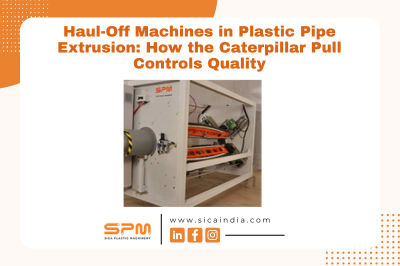
- POWERPULL haul-off -pulls pipe from the extruder at controlled speed with constant pulling power, using independently driven caterpillars with anti-slip rubber pads.
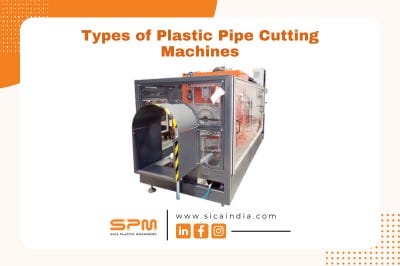
- SHARPSAW cutter -cuts and chamfers to precise length, with chip extraction to keep debris out of the bore.
- AUTOFEED collection magazine -buffers from both lines and meters single pipes into socketing.
- FASTFORM belling machine -forms the socket.
- RINGFIT -inserts the rubber ring where required.
- Link channels and palletizing -move and stack finished pipe.
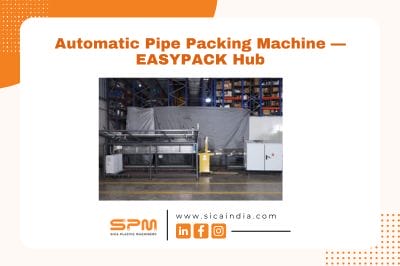
- EASYPACK and packing -bundle, strap or bag for dispatch.
A useful sanity check during layout: if any single stage in that chain has a cycle time longer than the stage feeding it, the magazine will fill and stay full. Reviewing the complete downstream pipe extrusion equipment range against your throughput targets before finalising the layout is worth the hour it takes. For corrugated production, corrugated pipe downstream equipment covers the equivalent handling arrangement, where AUTOFEED collection tables and link channels manage pipe movement post-cutting.
7. Commissioning and maintenance checklist
1. Verify the separation mechanism under load. A metering gate that isolates a single pipe from an empty bed may double-feed from a full one. Test at full capacity.
2. Check axial alignment to the belling machine. A pipe presented off-axis loads incorrectly and can produce a non-perpendicular socket face.
3. Confirm the interlock with the belling cycle. The feeder should be demand-driven. A timer-driven feeder will drift out of step within a shift.
4. Inspect contact surfaces for pipe marking. Any surface that scratches PVC will scratch it consistently -check early.
5. Confirm electrical supply. Link channels require an independent electrical connection; confirm the same for the feeder during installation planning.
6. Set support spacing for the longest cut length. Thin-walled 6 m pipe sags between widely spaced supports and presents incorrectly.
8. Frequently asked questions
What is a magazine for pipe collection?
An accumulation bed that receives cut pipes from one or more extrusion lines, buffers them, and releases them individually to the next machine. In a downstream pipe extrusion line the next machine is normally the belling machine, and the release mechanism is what separates a magazine from a simple storage rack.
Can one belling machine serve two extrusion lines?
Yes, provided the belling machine’s cycle capacity exceeds the combined output of both lines and a collection magazine buffers the input. Without buffering the belling machine will either idle or be manually fed. See how dual extrusion lines are handled with FASTFORM.
What pipe diameters does AUTOFEED 200 handle?
The published range is 40 mm to 200 mm, for 3 m and 6 m PVC pipes. Several models are available across the range -see the AUTOFEED page for current specifications.
Is a collection table the same as a tilt table?
No. A collection table feeds pipes into the belling machine; a tilt table receives finished socketed pipes as they fall out of it. They sit on opposite sides of the same machine.
Can this equipment be added to an existing line?
SICA India downstream equipment is designed to integrate with any make of extrusion line without requiring an overhaul of existing machinery. Contact the team with your current layout and cut lengths for a configuration recommendation.