Plastic Pipe Cutting Machines – Four Fundamental Types
Four fundamental plastic pipe cutting machine types exist: fly-knife, guillotine, saw and planetary cutters. Each suits different pipe diameters, materials, wall thicknesses and line speeds.
What Are Plastic Pipe Cutting Machines?
Plastic pipe cutting machines are specialized downstream extrusion equipment designed to cut plastic pipes, tubes and profiles to precise lengths while maintaining clean edges and dimensional accuracy. The right cutting technology depends on pipe diameter, material type, wall thickness, production speed and cut quality requirements.
On a continuous extrusion line the cutter has to work on a pipe that never stops moving. That single constraint — cutting a product that is still travelling — is what separates production cutting equipment from a workshop saw, and it is why four distinct mechanisms have evolved rather than one.
Four Cutting Technologies at a Glance
| Cutting Machine Type | Best For | Cutting Method | Key Advantage | Produces Chips? |
| Fly-Knife Cutter | Small, soft tubes and profiles | Rotating blade slices material | High-speed cutting with clean edges | No |
| Guillotine Cutter | Soft, flexible or sticky materials | Vertical blade cuts downward | Handles materials that may clog saws | No |
| Saw Cutter | Large, rigid or thick-walled pipes | Circular saw blade | Ideal for PVC and heavy-duty applications | Yes — extraction required |
| Planetary Cutter | Precision tubing and premium applications | Cutting wheel or knife orbits the pipe | Burr-free, distortion-free, square cuts | Depends on tool |
This comparison covers the four fundamental plastic pipe cutting technologies used in modern extrusion lines. Each system balances speed, accuracy, material compatibility and operational efficiency differently.
The Four Fundamental Types of Plastic Pipe Cutting Machines
Plastic pipe cutting machines are essential across industries for cutting pipes to precise lengths and shapes. Understanding how each mechanism works helps manufacturers select equipment that matches their production requirements rather than over-specifying or under-specifying the line.
1. Fly-Knife Cutters
Fly-knife cutters are widely used for their efficiency and precision on smaller, softer tubes and profiles. These machines use one or more blades in a chopping or slicing motion to make quick, clean cuts.
- Mechanism — a flywheel generates the cutting inertia for a blade mounted on it.
- Drive — a motor transfers rotating force through planetary reduction gears.
- Why the gearing matters — the gears increase torque and cutting force while protecting the motor and motor shaft from cutting shock.
- Best applications — thin-wall tubing and profiles where speed and edge neatness are the priority.
- Limitation — cutting force is limited, so thick-walled or large-diameter rigid pipe is outside its range.
2. Travelling or Guillotine Cutters
Guillotine cutters use a vertical blade that slices through the extrudate in a downward motion.
- Best applications — soft or sticky extrusions that would clog fly knives or saw blades, such as thermoplastic elastomers and polyurethanes.
- Large-diameter handling — the cutter is mounted on a moving table to accommodate continuous flow and longer cutting times.
- Small-diameter handling — smaller guillotine units process the product quickly without a travelling carriage.
- Position in the range — this type occupies the niche between travelling saws and fly-knife cutters.
3. Saw Cutters
Saw cutters suit larger plastic pipes and extrusions made from relatively hard, thick or brittle materials such as rigid PVC. They are essentially large circular saws adapted for plastic.
Trade-off — high cutting capacity on thick walls, at the cost of chip management.
Synchronisation — usually mounted on moving tables that match the extrusion line speed, ensuring square cuts on continuously flowing product.
Cutting sequence — the extrudate is temporarily clamped to the table; after the cut, the table retracts and repositions for the next length.
Byproduct — unlike other methods, saw cutting produces sawdust, which must be collected by a vacuum or chip extraction system.
4. Planetary Cutters
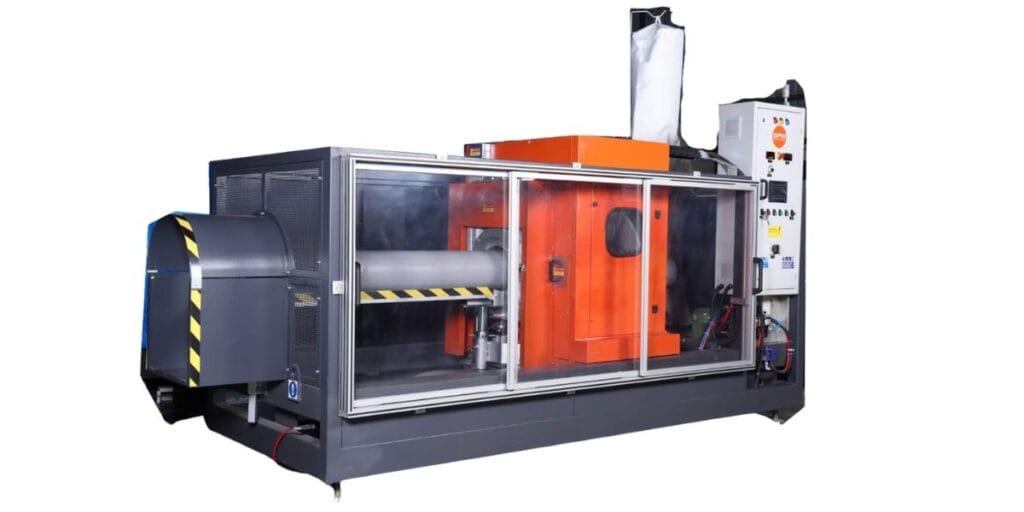
Planetary cutters are built for high-precision applications where cut quality cannot be compromised. They deliver square, distortion-free, particle-free cuts on rigid tubing.
- Mechanism — a circular cutting wheel is held inside a rotating ring that encircles the pipe. As the ring rotates, the wheel is pressed inward, cleanly severing the tube without removing material.
- Mounting — like other cutters, planetary units are mounted on movable tables to ensure square cuts on moving product.
- Cut quality — no material removal means no swarf inside the bore, which matters for potable water, gas and high-purity applications.
- Industrial use — the planetary principle is the basis of most modern high-speed inline pipe saws, including combined cutting-and-chamfering machines.
What Determines the Right Cutting Technology
Five variables decide which of the four mechanisms belongs on your line:
- Pipe diameter — small tubing suits fly-knife and planetary units; large-diameter pipe needs saw or heavy planetary systems.
- Material — rigid PVC and PP cut cleanly with a disc or saw system; flexible HDPE and PPR behave differently and generally call for a knife-based approach.
- Wall thickness — thick walls need hydraulic cutting arms and higher torque.
- Line speed — the faster the extruder runs, the shorter the cutting cycle has to be, and the stronger the case for carriage synchronisation.
- Cut quality requirement — whether chips inside the pipe are acceptable is often the deciding factor.
For a fuller walkthrough of matching machine to material and line speed, see our guide on choosing a plastic pipe cutting machine.
Where Cutting Sits in the Downstream Line
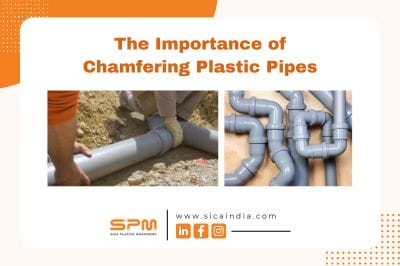
Cutting is not an isolated station. The pipe reaches the cutter already sized, cooled and pulled to length by the POWERPULL haul off machine, and leaves it heading for socketing on the FASTFORM belling machine. A cut that is out of square or burred will not seat correctly in the socket, which is why cutting and chamfering are usually specified together — see why chamfering plastic pipes matters. The complete station-by-station sequence is covered in our overview of downstream pipe extrusion equipment.
SICA India SHARPSAW: Planetary Cutting for Production Lines
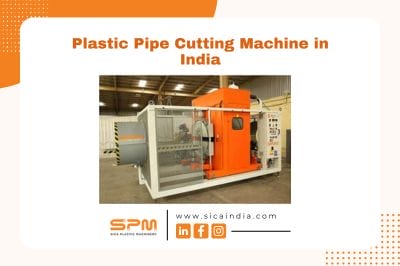
When it comes to cutting plastic pipes on a production line, the SHARPSAW pipe cutting machine from SICA India applies the planetary principle described above in three configurations, each matched to a different material group. SHARPSAW handles HDPE, PPR, PVC and PP.
SHARPSAW D Version — Disc Cutting and Chamfering
A planetary saw for cutting and chamfering rigid pipes in PVC, PE and PP, using a planetary disc rotary system with high-speed servo motors and pipe clamps.
- Hydraulically driven cutting arm with a feeler pin — cuts and chamfers thick-walled pipes effortlessly, including out-of-round (oval) pipes.
- Chamfer depth adjusted automatically.
- Short cutting cycles suited to high extrusion speeds.
- Dynamically balanced cutting rotor for accurate cutting at speed.
- Chip extraction system with dust collection for a clean work area.
SHARPSAW K Version — Knife Cutting Without Chips
A planetary saw with a knife for cutting rigid PE and PP pipes without producing chips or scrap, using a planetary knife system, high-speed motors and pipe clamps for HDPE and PPR.
- Hydraulically driven cutting arm cuts through thick-walled pipes effortlessly.
- Dynamically balanced cutting rotor delivers accurate cuts with no rough edges at high speed and reduces strain on moving parts.
- The 250K and 400K models feature swarfless cutting units — no swarf or chips, which matters for potable water and gas pipe where internal cleanliness is mandatory.
SHARPSAW DK Version — Combined Disc and Knife
A planetary saw for combination cutting of rigid pipes in PVC, PE and PP, covered in detail in our article on the SHARPSAW DK series.
- Combined cutting system using two arms: one carries a cutting disc and/or milling cutter, the other a knife. The disc arm cuts to a given depth first; the knife arm completes the cut through the remaining wall thickness, so no chips get inside the pipe.
- Hydraulically driven cutting arm with feeler pin — chamfers and cuts thick-walled and out-of-round pipes.
- Chamfer depth adjusted automatically.
- Chip extraction system.
Key Features of SICA India SHARPSAW
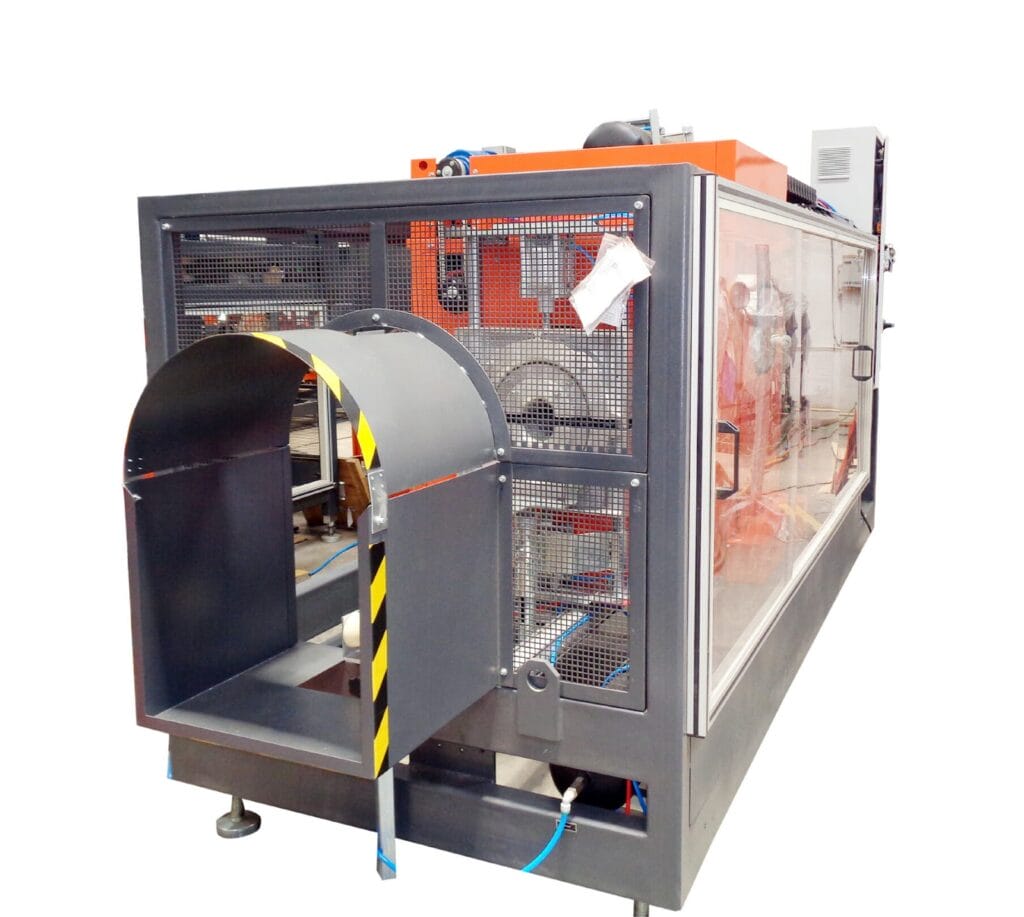
- Versatility — handles a wide range of plastic materials, from PE and PPR through to rigid PVC, across three cutting configurations.
- Precision cutting — the planetary cutting mechanism produces clean, square cuts with minimal material waste, which matters where tight tolerances are required.
- Efficient operation — short cutting cycles and dynamically balanced rotors support high-speed production without loss of accuracy.
- Optional synchronisation — adjusts carriage speed as extrusion speed varies, improving cut-length accuracy.
- Optional CNC “cutting on the fly” — a SICA patent that allows cutting in groups of long and short pipes without the cutting carriage returning home.
- Integrated chamfering — the D and DK versions combine cutting and chamfering in one machine, covered further on our cutting and chamfering machine page.
- Low maintenance — durable construction reduces downtime and operational cost.
A deeper look at how these features translate on the production floor is available in the SHARPSAW advantage.
Frequently Asked Questions
What are the four types of plastic pipe cutting machines?
The four fundamental types are fly-knife cutters, guillotine or travelling cutters, saw cutters, and planetary cutters. They differ in cutting mechanism, material suitability and whether they generate chips.
Which cutting machine is best for PVC pipe?
Rigid PVC is generally cut with a disc or saw system. Planetary disc saws such as the SHARPSAW D version cut and chamfer PVC and PP in a single operation with automatic chamfer depth adjustment.
Which cutting machine is best for HDPE pipe?
HDPE and PPR are better suited to knife-based planetary cutting. A planetary knife system severs the pipe without producing chips or swarf inside the bore, which is required for water and gas pipe.
What is a swarfless cutter?
A swarfless cutter severs the pipe without removing material, so no chips, dust or scrap are generated. This keeps the pipe bore clean and eliminates the need for chip collection on that station.
Do plastic pipe cutting machines need to be synchronised with the extruder?
On continuous lines, yes. Carriage synchronisation adjusts cutting-table speed as extrusion speed varies, which keeps cut length accurate and the cut face square.
Choosing the Right Cutting Machine for Your Line
The four fundamental cutting technologies exist because no single mechanism handles every diameter, material and line speed well. Match the mechanism to your pipe first, then specify the machine.
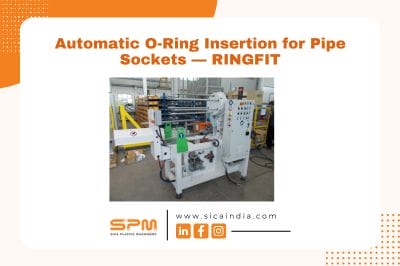
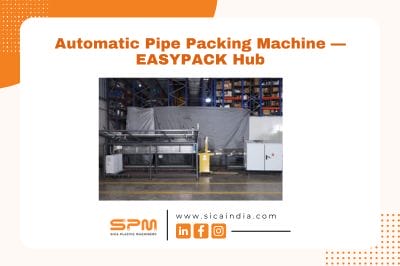
SICA India manufactures downstream plastic pipe extrusion equipment in Mumbai as a joint venture between SICA S.p.A. of Italy and Satellite Plastic Industries, supplying cutting, chamfering, haul-off, belling, ring insertion and packing machines for PVC, HDPE, PP and corrugated pipe lines. For availability and configurations in the Indian market, see plastic pipe cutting machine in India.
To specify a cutter matched to your pipe range, material and line speed, contact the SICA India team.