Cutting sounds like the simplest step in a pipe line — until a cut goes out of square, burrs the bore, or wastes material at high line speed. The right plastic pipe cutting machine depends on the material, the wall thickness, and how fast the extruder is running. This guide walks through the main cutter types and where each one fits.
The Four Fundamental Types of Cutters
Most plastic pipe cutting comes down to four mechanisms. We cover each in detail in the four fundamental types of plastic pipe cutting machines — here is the short version:
- Fly-knife cutters — a flywheel-mounted blade slices smaller, softer tubes and profiles quickly and cleanly. Best where speed and neatness matter on thin material.
- Guillotine / travelling cutters — a vertical blade slices downward; effective on soft or sticky extrusions that would clog other cutters.
- Planetary cutters — a blade or disc orbits the pipe for a clean, square cut on rigid pipe; the basis of most high-speed inline saws.
- Saw cutters — rotary saw blades cut thick-walled and large-diameter pipe with chip extraction to keep the work area clean.
Match the Cutter to the Material
Material drives the choice as much as diameter. Rigid PVC and PP cut cleanly with a disc/saw system; flexible HDPE and PPR behave differently and often call for a knife-based approach. This is exactly why a modern inline cutter is offered in more than one version.
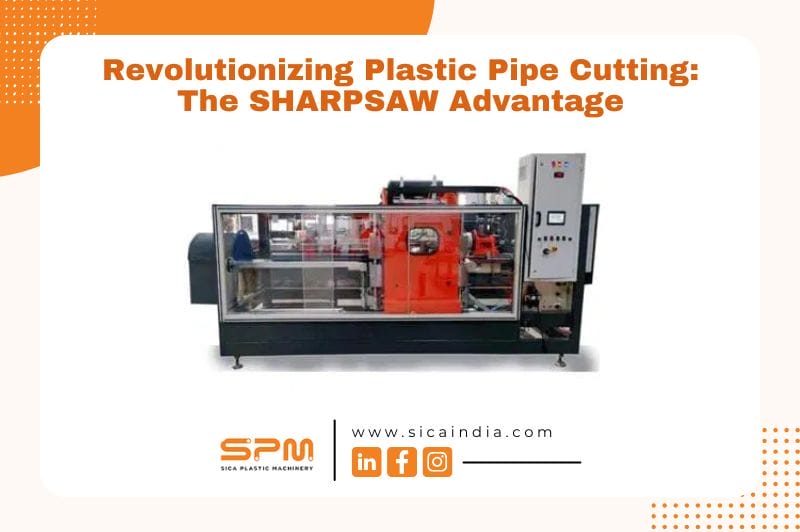
The SHARPSAW pipe cutting machine is built around this split: the D Version uses a planetary disc rotary system with high-speed servo motors for precise cutting of PVC and PP, while the K Version uses a planetary knife system for HDPE and PPR. Both clamp the pipe for a square cut and are designed for the short cutting cycles that high extrusion speeds demand.
Cutting and Chamfering in One Pass
On finished pipe, the cut end usually needs a chamfer — a beveled edge so the pipe slides into a fitting without shaving the sealing ring. Doing both in one station saves a handling step. If your requirement is specifically the combined operation, see the dedicated cutting and chamfering machine, where cut and chamfer happen in the same cycle with an adjustable chamfer depth.
Editorial: this split resolves the /sharpsaw/ cannibalisation — ‘pipe cutting’ intent anchors point to /sharpsaw/, ‘cutting & chamfering’ intent anchors point to /sharpsaw-chamfering-machine-india/. Keep this separation site-wide.
What to Look For on a Production Line
- Cut squareness — clamps that hold the pipe true, even on out-of-round stock.
- Short cycle time — the cutter must keep up with line speed, not slow it.
- Chip / dust extraction — a dust collection system keeps swarf out of the bore and off the floor.
- Material versatility — the ability to switch between PVC, PP, HDPE and PPR without a second machine.
For a closer look at how a servo-driven inline saw improves cut quality and reduces waste, read the SHARPSAW advantage.
Where Cutting Fits in the Line
Cutting sits between haul-off and socketing in the finishing sequence. The pipe is pulled and cooled, cut to length (and chamfered), then socketed and packed. See the whole sequence on our downstream pipe extrusion equipment hub.
Not sure which version fits your material and speed? Talk to SICA India for a cutter spec matched to your line.