End-of-line handling is the least engineered stage in most Indian pipe plants and the most common place output is quietly lost. Pipe that survives extrusion, cutting and socketing intact gets scratched in a manual buffer, deformed in an uneven stack, or simply sits waiting because four people cannot bundle as fast as one line produces.
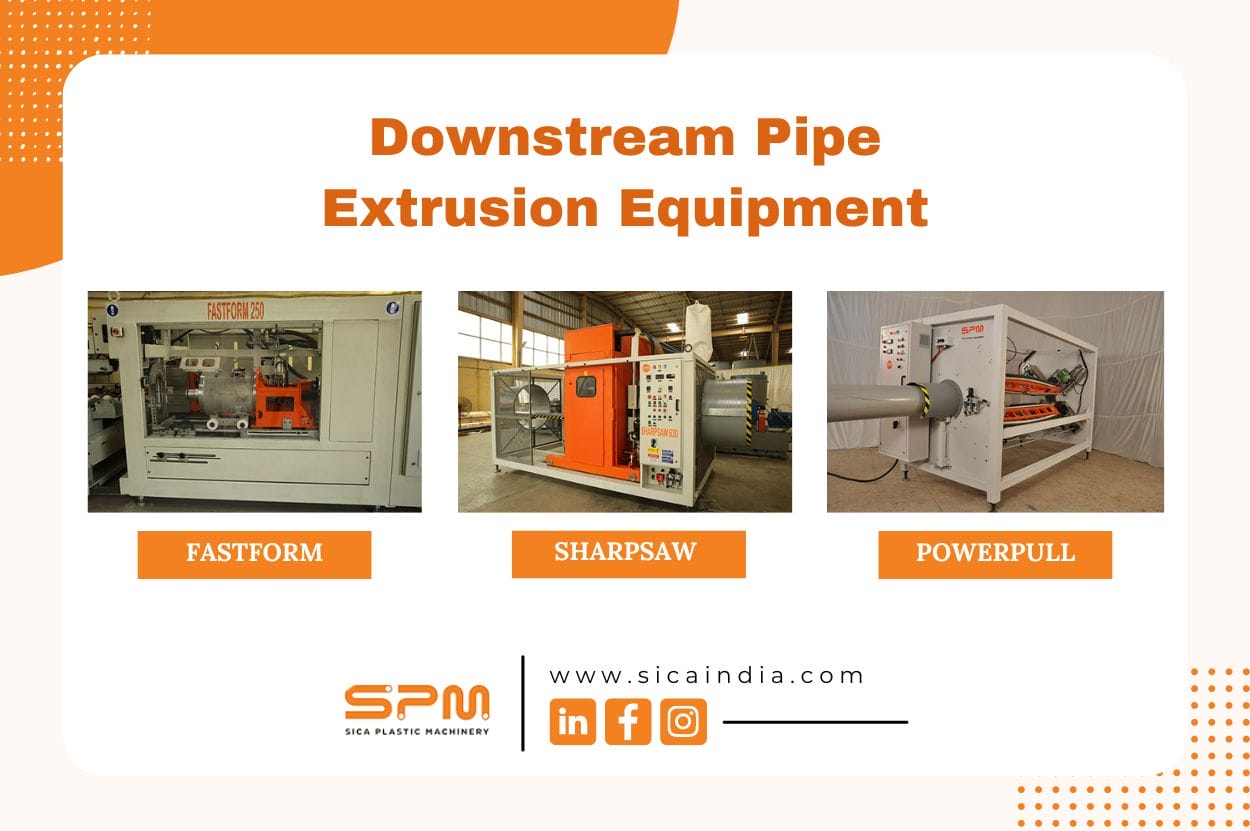
This guide walks the five stages between the belling machine and the truck, sets out what each stage has to achieve, and identifies the specification decisions that determine whether your end-of-line keeps pace or becomes the constraint. The upstream stages are covered in the downstream pipe extrusion equipment overview.
Why End-of-Line Handling Caps Your Effective Line Speed
An extrusion line is continuous up to the cutter and discrete after it. Once pipe is cut, every subsequent stage handles individual pieces, and individual-piece handling has a rate limit that manual labour cannot scale past without adding headcount linearly.
Manual end-of-line handling imposes four costs, and only one of them appears on a labour line item:
- Rate ceiling. People bundle at a fixed rate. When the line speeds up, the buffer grows until someone stops the line.
- Damage. Scratches, dents and deformation from manual handling are the classic end-of-line reject mode — and they occur after all the value has been added.
- Inconsistency. Hand-counted bundles vary. Variable bundles do not stack predictably, which pushes the problem into the warehouse and onto the truck.
- Dispatch lag. Packaging that cannot keep pace with extrusion output creates a bottleneck at exactly the point where finished goods should be converting to revenue.
Automating the stage addresses all four: consistent package quality, reduced labour dependency, prevention of manual-handling damage, and packaging that keeps pace with line output speed.
Stage One – Getting Pipe Off the Line
The first move is lateral. Pipe leaves the socketing station along the line axis and has to be transferred sideways into the packing area without being dragged, dropped or stacked on itself.
Link channels
SICA India Link Channels are belt channels of 3.0 m or 6.0 m length for moving pipe from OD 32 mm to OD 250 mm, and for subsequent sideways unloading onto a palletizer or a downstream station. The channel is positioned at the side of the belling machine bench with adjustable height, slides on floor supports, and takes belt speed adjustment via inverter. It requires connection to an independent electrical system.
| Model | Min. dia. (mm) | Max. dia. (mm) | Max. pipe length (mm) | Installed power (kW) | Pipe types |
| LINK 250 – 3 METERS | 32 | 250 | 3000 | 0.74 | Agri, SWR, Corrugated |
| LINK 250 – 6 METERS | 32 | 250 | 6000 | 1.9 | Agri, SWR, Corrugated |
The inverter matters more than the power rating. Belt speed has to be matched to the rate pipe is arriving from the belling machine — run it too fast and pipes gap out and arrive at the bundler unevenly; too slow and they collide on the belt. Where ring insertion is fitted, the link channel is also the connection method: the RINGFIT 160 ring insertion device attaches to any belling machine by connecting a link channel, so the transfer stage and the ring insertion stage are specified together, not separately.
Tilt tables
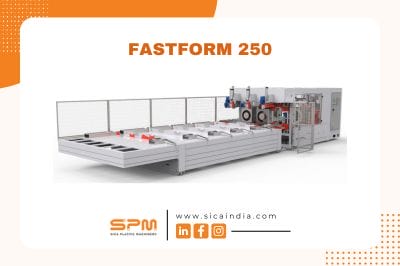
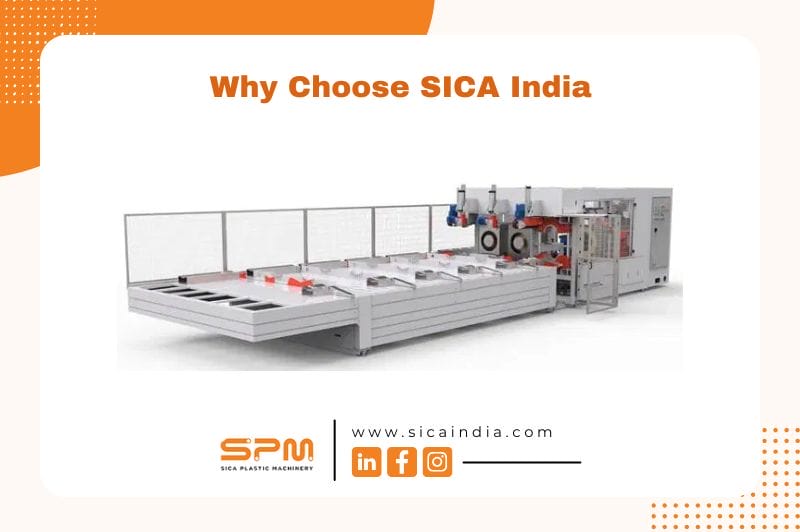
After socketing on the FASTFORM belling machine, finished pipe falls onto tilt tables that collect and organise it for palletizing. A tilt table is a buffer with a controlled release -it accumulates a layer of pipe and then tips it into the next stage as a group, which is what allows a continuous line to feed a batch-based bundler.
Collection tables
On twin-line installations the AUTOFEED collection table performs the reverse function on the infeed side, collecting pipe from two extrusion lines and presenting it to the belling machine one pipe at a time. The same principle applies at both ends of the socketing station: controlled single-piece presentation beats gravity-fed accumulation every time.
Stage Two – Counting and Bundling
Bundling is where package economics are decided. A bundle is the unit your warehouse stacks, your forklift lifts and your customer receives, and its geometry determines how many pipes fit on a truck.
The EASYPACK automatic pipe packing machine handles counting and bundling as the first two of four sequential automated stages. Pipes are counted automatically as they enter, so every bundle holds an exact, consistent pipe count with no manual tallying; counted pipes are then arranged and aligned into uniform bundles, configurable from 24 pipes per bundle up to 100 pipes per bundle depending on diameter and bundle specification.
Two bundle geometries dominate:
- Hexagonal. Pipes nest into the natural close-packed arrangement. Highest density per unit volume, and the bundle is self-stabilising under strapping tension.
- Rectangular. Squarer footprint, stacks more predictably on standard pallets and in containers, at slightly lower packing density.
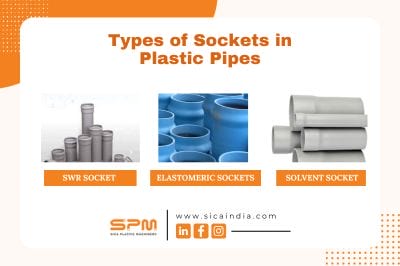
The socket-end problem. Socketed pipe is not a cylinder — it has an enlarged bell at one end. Bundle socketed pipe as though it were plain and the bundle develops a taper, strapping tension distributes unevenly, and the stack becomes unstable. End-of-line equipment has to account for the enlarged socket end created by the belling machine, orienting pipes correctly during bundling so alternate pipes reverse and the bundle stays parallel. If you are specifying handling for socketed pipe, confirm socket-end orientation is part of the machine’s function — see types of sockets in plastic pipes for how socket profiles differ.
Stage Three – Strapping
Strapping converts a stack of pipes into a single handling unit. It is a straightforward operation that fails in two specific ways: too few straps and the bundle articulates and spills during a lift; too much tension and the outer pipes are crushed or ovalised, which on thin-wall pipe is a rejection.
In the EASYPACK sequence, each bundle is strapped in three or four phases as required, holding pipes tightly and securely for safe stacking, storage and transport. The phased approach is the mechanism that solves the tension problem — progressive strapping at multiple points along the bundle length distributes load rather than concentrating it. Strap count should scale with bundle length: a 6 m bundle strapped at two points will sag between them.
Stage Four – Bagging and Film Wrapping
The finished, strapped bundle is wrapped and packed in LDPE film, protecting the pipe from dust and handling damage through to delivery. This stage is often treated as cosmetic. It is not — for conduit, plumbing and potable-adjacent pipe, a wrapped bundle is the only thing standing between a clean bore and a site-yard contamination claim.
Flexible pipe takes a different route through this stage: coiled pipe is wound to specified lengths and then wrapped or bagged for transport. SICA India’s broader pipe bagging and packaging solutions cover both straight-length bundling and coiled-pipe bagging.
The full four-stage EASYPACK sequence — counting, bundling, strapping, bagging — is described in detail in our guide to the automatic pipe packing machine.
Stage Five – Palletizing and Stacking
After bundling, pipe is stacked on pallets for forklift handling. SICA India pipe palletizing and stacking equipment covers the handling chain that feeds this stage — link channels and tilt tables managing pipe flow from production into the palletizing area.
A scope note worth having up front. SICA India specialises in downstream pipe extrusion equipment and supplies the pipe handling systems — link channels, tilt tables and collection tables – that feed into palletizing systems, rather than full palletizing robots. If your project requires an integrated robotic palletizing cell, the handling equipment is specified to interface with it. Discuss the interface early, because the pallet pattern determines the bundle geometry, which determines the bundler configuration upstream of it.
Three specification points decide whether a palletizing stage works:
- Pallet pattern and bundle geometry must be decided together. You cannot design the bundle after buying the palletizer, or vice versa.
- Stack height is limited by the bottom bundle, not the top. Crushing loads accumulate downward; thin-wall pipe sets the limit for the whole stack.
- Forklift access has to be designed in. Bundle spacing and pallet entry direction are handling decisions made at the bundler, not in the warehouse.
Coiled Pipe: A Different End-of-Line Entirely
Small-diameter flexible pipe – HDPE, PE-RT, PEX – is not cut and bundled. It is coiled continuously to specified lengths, then wrapped or bagged for transport. This removes the cutter, the belling machine and the bundler from the line and replaces them with a coiling and wrapping stage.
Coiling systems for flexible pipe are developed by SICA Italy and available through the SICA India product range. The commercial logic is straightforward: coiled pipe eliminates joints across long runs, which for drip irrigation laterals, telecom ducting and rural water schemes is the whole point of the product. Straight-length handling equipment does not transfer to coiled production, so if you run both, they are two separate end-of-line investments. The distinction is set out in the HDPE pipe extrusion line downstream guide.
Specification Checklist Before You Buy
Run these eight questions before committing to end-of-line equipment. Each one has caused a retrofit somewhere.
| # | Question | Why it decides the specification |
| 1 | What is your pipes-per-hour rate at maximum line speed? | End-of-line capacity must exceed line output, not match it |
| 2 | Is the pipe socketed or plain-ended? | Socketed pipe requires socket-end orientation during bundling |
| 3 | What diameter range must one machine cover? | Determines whether one unit serves the plant or you need two |
| 4 | Straight lengths, coils, or both? | These are different machines, not settings on one machine |
| 5 | How many extrusion lines will feed the stage? | Offline packing lets one machine serve several lines |
| 6 | Hexagonal or rectangular bundles? | Sets bundle geometry, strapping pattern and pallet pattern |
| 7 | What is the required bundle count? | Bundle size drives machine configuration and strap phasing |
| 8 | Is ring insertion in the line? | RINGFIT connects to the belling machine via a link channel |
The complete machine range, from haul-off through to packing, is on the SICA India products page.
Frequently Asked Questions
Does SICA India manufacture full palletizing robots?
No. SICA India specialises in downstream pipe extrusion equipment and provides the pipe handling systems – link channels, tilt tables and collection tables- that feed into palletizing systems. Contact the team to discuss specific palletizing requirements.
What pipe sizes can the handling equipment manage?
Link Channels handle pipe from OD 32 mm to OD 250 mm in 3.0 m and 6.0 m lengths. For larger pipe sizes, custom solutions are available. Packing configurations are available for pipe from OD 16 mm to OD 630 mm and beyond depending on the packaging configuration.
Can end-of-line equipment handle socketed pipe?
Yes. Packaging solutions account for the enlarged socket end created by the FASTFORM belling machine, with pipes oriented correctly during bundling so the bundle stays parallel and strapping tension distributes evenly.
Can packing and handling machines be added to an existing line?
Yes. SICA India equipment is designed for seamless integration with any make of extrusion line and integrates without requiring an overhaul of existing machinery.
Should packing run inline or offline?
Offline packing lets a single machine serve the output of several extrusion lines, which decouples packing capacity from any one line’s cycle time and is generally the more cost-effective configuration for multi-line plants.
Specify your end-of-line before it becomes the bottleneck. Send SICA India your pipe range, bundle specification and number of lines feeding the stage — contact SICA India. Company background and manufacturing base: about SICA India.