Extruder capacity is easy to buy. Downstream capacity is easy to under-buy – and it is the downstream that sets your actual output. A line rated at 25 m/min that spends its shift waiting on a belling cycle is a 14 m/min line with an expensive extruder attached.
This guide sets out how to calculate what your downstream can genuinely absorb, where the four capacity ceilings sit, and which of them is limiting you right now. Every figure quoted below comes from published SICA India machine specifications; the arithmetic connecting them is shown so you can substitute your own numbers. For the full stage-by-stage machine inventory, start with the downstream pipe extrusion equipment overview.
What ‘High Speed’ Actually Means Downstream
Upstream, speed is output in kilograms per hour. Downstream, speed is metres per minute – and then, after the cutter, it stops being a continuous quantity altogether and becomes discrete: pipes per hour.
That conversion is the single most useful calculation in line planning:
| Quantity | Formula | Why it matters |
| Line speed | metres per minute (m/min) | Set by the haul-off; capped by cooling and by haul-off model |
| Pipes per hour | (line speed × 60) ÷ cut length in metres | The number every discrete downstream stage must match |
| Downstream takt time | 3600 ÷ pipes per hour (seconds) | The time budget each discrete machine has per pipe |
Worked conversion. A line running 6 m pipe at 20 m/min produces (20 × 60) ÷ 6 = 200 pipes per hour, giving a takt time of 3600 ÷ 200 = 18 seconds per pipe. Every discrete stage after the cutter – socketing, ring insertion, transfer, bundling – must complete inside 18 seconds or it becomes the bottleneck. Shorten the cut length to 3 m and the same line speed produces 400 pipes per hour and a 9-second takt. Cut length is a downstream capacity decision, not just a commercial one.
The Four Capacity Ceilings
Downstream capacity is not a single number. It is the lowest of four independent ceilings, and raising any ceiling other than the binding one buys you nothing.
- Haul-off pull speed – the hard m/min limit for your diameter class.
- Cutting cycle time -how long the carriage is committed per cut, and whether it must return home between cuts.
- Belling cycle time – heating and forming time per socket. On most PVC lines, this is the binding constraint.
- End-of-line handling – transfer, ring insertion, bundling and packing throughput.
Ceiling 1 – Haul-Off Pull Speed
Maximum line speed is a published property of the haul-off model, and it falls sharply as diameter rises. The POWERPULL haul-off range illustrates the trade-off precisely:
| Model | Diameter range (mm) | Caterpillars | Max. standard speed (m/min) |
| POWERPULL 125-2 | 10 – 125 | 2 | 35 |
| POWERPULL 160-3 | 10 – 160 | 3 | 23 |
| POWERPULL 250-4 | 40 – 250 | 4 | 20 |
| POWERPULL 400-4 | 40 – 400 | 4 | 14 |
| POWERPULL 500-4 | 63 – 500 | 4 | 11 |
| POWERPULL 630-6 | 160 – 630 | 6 | 4 |
Note what this table tells you about small-diameter production: a 125 mm class line can run nearly nine times the linear speed of a 630 mm line. Small-bore lines therefore hit downstream ceilings first and hardest, because they generate pipes per hour at a rate the discrete stages were never sized for. POWERPULL’s independently driven caterpillars, long contact length and anti-squashing control exist to hold dimensional accuracy at those speeds — the mechanism is explained in how the caterpillar pull controls quality.
Ceiling 2 -Cutting Cycle Time and Cutting on the Fly
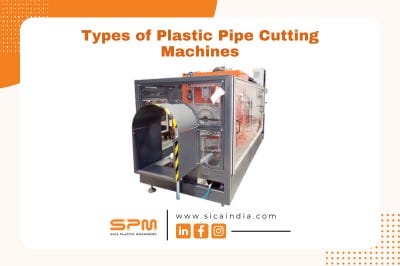
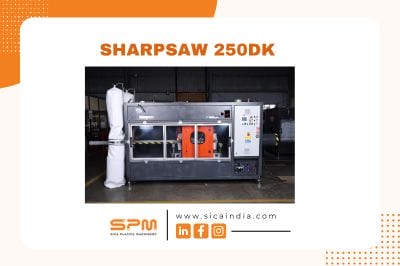
A cutter has to travel with the pipe, cut, chamfer, retract and reposition – all while the line keeps moving. Three SHARPSAW features exist specifically to stop this stage becoming the ceiling.
Short cutting cycles
The D series uses a hydraulically driven cutting arm with a feeler pin and a dynamically balanced cutting rotor, giving short cycles suitable for high extrusion speeds and accurate cuts even when the rotor is running fast. Chamfer depth adjusts automatically, so chamfering does not add a separate operation to the cycle.
Carriage synchronisation
Optional synchronisation adjusts carriage speed as extrusion speed varies. Without it, every speed fluctuation upstream shows up as cut-length variation – which on a socketed line becomes a downstream rejection, not just a trim allowance.
Cutting on the fly
Computerised Numerical Control enables cutting on the fly, a SICA patent that permits cutting in groups of long and short pipes without the cutting carriage returning home between cuts. Removing the return stroke removes dead time from the cycle, and on short cut lengths that dead time is often the difference between a cutter that keeps up and one that does not.
Which SHARPSAW series you need depends on material as much as speed — the K series planetary knife system for rigid PE and PP, the D series planetary disc for PVC and PP, and the DK series combining both arms. That comparison is set out in our guide to choosing a pipe cutting machine in India and in the SHARPSAW advantage.
Ceiling 3 – The Belling Machine, Usually the Real Bottleneck
Socketing is a thermal process. The pipe end must be heated to forming temperature, formed, and cooled enough to hold shape before release. Unlike cutting, you cannot compress that cycle by adding motor power – heat transfer sets the floor.
This is why belling capacity, not cutter capacity, is the ceiling on most socketed PVC lines. The FASTFORM automatic inline belling machine attacks the problem structurally rather than by rushing the cycle:
- Dual oven design. Pipe is fed directly from the cutter, conveyed to the first oven, then the second, and then socketed. Two ovens working in sequence keep a pipe heating while another is being formed, so the forming station is not idle during heat-up.
- Published throughput. FASTFORM 90 and FASTFORM 110 are rated at up to 400 sockets per hour – which, against the takt table above, covers a single 6 m line at 20 m/min twice over, or a twin-line 6 m installation exactly at capacity.
- Tooling that avoids a second operation. Plain socketing tools for solvent cement sockets, tools with an outside mould for SWR sockets including logo and diameter engraving, and a mechanical collapsible mandrel for SWR or elastomeric ring sockets – with zero pipe wastage.
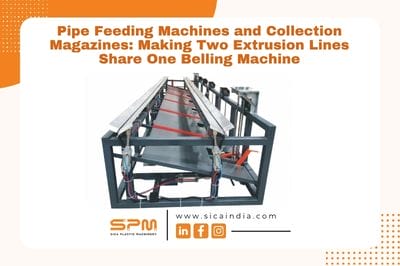
Where two extrusion lines feed one belling machine, the feed logistics become the constraint rather than the belling cycle itself. The AUTOFEED 200 collection table exists for exactly this: it collects pipe from twin lines and feeds the belling machine one pipe at a time, across OD 40 mm to OD 200 mm, at an installed power of 2 kW. The wider case for running two lines into one socketing station is made in dual extrusion lines and socket perfection.
For small-diameter high-speed work there is a second structural answer — form more than one socket per cycle. The MULTIFORM belling range does this:
| Pipes per cycle | MULTIFORM 110 — OD range (mm) | MULTIFORM 200 — OD range (mm) |
| 1 pipe | — | 120 – 200 |
| 2 pipes | 63 – 110 | 63 – 110 |
| 3 pipes | 63 – 75 | 63 – 75 |
| 4 pipes | 16 – 50 | 16 – 50 |
Read that table as a capacity multiplier. At OD 16–50 mm, four sockets per cycle means the belling stage clears four pipes per takt period instead of one. Small-bore lines are precisely where pipes-per-hour is highest, so this is where multi-cavity socketing changes the arithmetic most. Selection criteria across the belling range are covered in how to choose a belling machine.
Ceiling 4 – Ring Insertion and End-of-Line Handling
For elastomeric and SWR socketed pipe, ring insertion is a discrete stage with its own rate. The RINGFIT 160 ring insertion device runs at up to 400 pipes per hour depending on diameter, covers OD 50 mm to OD 160 mm, and holds up to 300 rings in its cartridge. That cartridge figure is a capacity number in disguise: at 400 pipes per hour, 300 rings is roughly 45 minutes of unattended running before a reload. If your shift plan does not account for reload stops, your effective rate is lower than the rated one.
Beyond ring insertion, packing is the last place a fast line can stall. The EASYPACK automatic pipe packing machine is designed to run offline so a single unit serves several extrusion lines, which decouples packing capacity from any one line’s cycle – a materially different architecture from an inline packer that must match takt exactly.
Worked Example: Debottlenecking a Twin 6 m PVC Line
Assume two extrusion lines, 6 m cut length, OD 110 mm, both running at 20 m/min into one socketing station.
| Stage | Rated capability | Required rate | Verdict |
| Haul-off | POWERPULL 250-4: up to 20 m/min | 20 m/min per line | At the limit – no headroom for speed increase |
| Cutting | Short cycles with CNC cutting on the fly | 200 pipes/hr per line | Adequate; synchronisation recommended |
| Feeding | AUTOFEED 200, OD 40–200, dual line | 400 pipes/hr combined | Required – manual feed will not hold takt |
| Belling | FASTFORM 110: up to 400 sockets/hr | 400 sockets/hr | Exactly at capacity – zero buffer |
| Ring insertion | RINGFIT 160: up to 400 pipes/hr | 400 pipes/hr | At capacity; plan for cartridge reloads |
| Packing | EASYPACK, offline, multi-line | 400 pipes/hr | Decoupled – not the constraint |
The diagnosis. Three stages sit exactly at capacity with no buffer, which in practice means any one of them stopping halts the pair of lines. The cheapest headroom here is not a bigger extruder – it is either reducing to a single-cavity-per-cycle load by moving to multi-cavity socketing at smaller diameters, adding a second socketing station, or accepting a lower line speed and running to a stable takt. Capacity planning to 100% of rated throughput is planning to fail on the first micro-stop.
Semi-Automatic and Fully Automatic: When the Upgrade Pays
Not every line needs a fully automatic inline belling machine, and buying one for a line that does not is capital sat idle. The distinction is concrete.
| Semi-automatic (FASTFORM 200 class) | Fully automatic inline (FASTFORM 250 / 400 class) | |
| Pipe loading | Operator inserts pipe on the mandrel manually | Pipe fed directly from the cutter, conveyed to oven one, then oven two |
| Cycle after loading | Heating, cooling and socketing fully automatic | Fully automatic end to end; finished pipe falls to tilt table or trolley |
| Diameter range | 63 – 200 mm | 50 – 250 mm (FASTFORM 250); 63 – 400 mm (FASTFORM 400) |
| Socket types | Solvent cement, O-ring pressure | Solvent cement, SWR, O-ring pressure (elastomeric) |
| Installation | Inline or offline | Inline |
| Best fit | Lower volume, frequent size changes, offline socketing | Continuous high-output production at stable takt |
The semi-automatic route is not a compromise on socket quality – the FASTFORM 200 guarantees a precise internal diameter and a socket perpendicular to the pipe axis, with a short combined heating-and-socketing cycle. It is a compromise on labour and on takt stability, which only matters if your line speed makes takt binding. For an in-house comparison of belling technologies, see the BSC belling machine overview, and for socket profile selection, types of sockets in plastic pipes.
Frequently Asked Questions
What is the maximum speed of a high-speed pipe extrusion line downstream?
Downstream speed is capped by the haul-off model and diameter. Published POWERPULL maximum standard speeds range from 35 m/min on the 125-2 model down to 4 m/min on the 630-6 model, so small-diameter lines run far faster than large-diameter lines.
Which downstream stage is usually the bottleneck?
On socketed PVC lines it is normally the belling machine, because socket forming is a thermal cycle that cannot be shortened by adding power. On plain-ended lines the bottleneck typically moves to cutting or to end-of-line handling.
How do I calculate how many pipes per hour my line produces?
Multiply line speed in metres per minute by 60, then divide by the cut length in metres. A 6 m line at 20 m/min gives 200 pipes per hour; the same line cutting 3 m lengths gives 400.
Does cutting on the fly really increase output?
It removes the carriage return stroke between cuts, which is dead time in every cycle. On short cut lengths, where cuts come frequently, eliminating that return is often what allows the cutter to hold takt at high line speed.
Can I increase output without replacing the extruder?
Usually yes. Most lines are downstream-limited, not extruder-limited. Multi-cavity socketing at small diameters, automatic feeding from twin lines, carriage synchronisation and offline packing all raise effective output without touching the extruder.
Get your line balanced against real numbers. Send SICA India your diameter range, cut length and target line speed and the engineering team will map each downstream stage against your takt time — contact SICA India. Background on the company and its manufacturing base is on why choose SICA India.