A corrugated pipe production line is judged on the corrugator, but it fails on the downstream. The corrugator forms the profile; everything after it decides whether that profile survives to the loading bay with its ring stiffness, its bore geometry and its joint faces intact. Get the downstream brief wrong and you produce a pipe that measures correctly at the mould and leaks in the trench.
This guide covers what actually changes downstream when you move from plain pipe to corrugated pipe – the grip problem at haul-off, the chip problem at cutting, the geometry problem at socketing, and the crush problem in handling. It is written for producers running or planning corrugated pipe machine and extrusion equipment lines in India, and it assumes you already understand plain-pipe extrusion.
Where the Corrugator Ends and the Downstream Begins
A corrugated line splits cleanly into two halves. The upstream half – extruder, die head and corrugator – melts the resin and forms the corrugation profile in travelling mould blocks. The downstream half takes over the moment the pipe leaves the last mould block and is responsible for pulling, cutting, finishing, collecting and packing it.
SICA India does not manufacture corrugators. The machines described here are the downstream stages that sit after any corrugator brand, and they are designed to integrate with existing lines without an overhaul of upstream equipment. If you want the complete stage-by-stage picture for plain pipe first, the downstream pipe extrusion equipment overview sets out the same sequence for PVC, HDPE and PP lines.
The stage order on a corrugated line is:
- Corrugator – forms the single-wall or double-wall profile in moving mould blocks.
- Haul-off – takes the pipe out of the corrugator at controlled speed and controlled grip.
- Cutting – cuts to length, at the corrugation valley, without crushing or contaminating the bore.
- Socketing (where specified) – forms the joint end for pipe supplied with a bell.
- Handling and collection – moves cut pipe sideways off the line to bundling, coiling or palletizing.
Why Corrugated Changes the Downstream Brief
Plain pipe presents a continuous cylindrical wall to every machine that touches it. Corrugated pipe does not. It presents an alternating sequence of ribs and valleys, and — in double-wall construction – a hollow annulus between a corrugated outer wall and a smooth inner wall. Three consequences follow, and they drive every specification decision downstream.
Contact area is discontinuous
Anything that grips a corrugated pipe touches only the rib crowns. The effective contact area is a fraction of what the same machine sees on plain pipe of the same outside diameter, which means grip pressure concentrates on narrow bands of material.
The section is hollow, not solid
A double-wall corrugated pipe derives its ring stiffness from geometry, not from wall mass. Crush a rib and you have not scratched the pipe — you have removed structural capacity from that section. Deformation downstream is a scrap event, not a cosmetic one.
Debris cannot be flushed out
On a plain pipe, cutting debris sits on a smooth bore and can be blown clear. On a corrugated bore, chips lodge in the valleys and stay there. For cable ducting and potable-adjacent drainage applications, internal cleanliness is a specification requirement, not a preference.
Haul-Off: Pulling a Profile Without Flattening It
The haul-off sets line speed and, more importantly, sets how much force is applied to the corrugation crowns while doing it. The POWERPULL haul-off machine pulls corrugated pipe with adjustable grip pressure so that the profile is maintained without deformation through the pulling stage.
Three POWERPULL design features matter specifically on corrugated work:
- Pivoted upper caterpillars with anti-squashing control. The upper track is pivoted rather than rigidly mounted, which is the mechanism that prevents progressive crushing when a rib passes under load.
- Natural rubber caterpillar pads. Non-marking pads conform to the rib crowns and spread load rather than concentrating it on a hard edge. They also grip without requiring the clamping force a smooth steel pad would need.
- Long caterpillar contact length. More ribs under the track at any moment means each rib carries a smaller share of the total pulling force — the single most effective way to reduce peak crown stress.
The POWERPULL range spans small-bore to large-bore work, with maximum standard line speed falling as diameter rises:
| Model | Min. dia. (mm) | Max. dia. (mm) | Caterpillars | Installed power (kW) | Max. speed (m/min) |
| POWERPULL 125-2 | 10 | 125 | 2 | 3.4 | 35 |
| POWERPULL 160-3 | 10 | 160 | 3 | 4.8 | 23 |
| POWERPULL 250-4 | 40 | 250 | 4 | 6.3 | 20 |
| POWERPULL 400-4 | 40 | 400 | 4 | 6.3 | 14 |
| POWERPULL 500-4 | 63 | 500 | 4 | 9.6 | 11 |
| POWERPULL 630-6 | 160 | 630 | 6 | 9.6 | 4 |
Caterpillar count is the primary sizing decision on corrugated lines: more tracks distribute pulling force around more of the circumference and reduce localised crown loading. For the underlying theory of how haul-off speed governs wall thickness and dimensional stability, see the role of the haul-off machine in downstream pipe extrusion.
Cutting Corrugated Pipe: Why Knife Tools Beat Discs
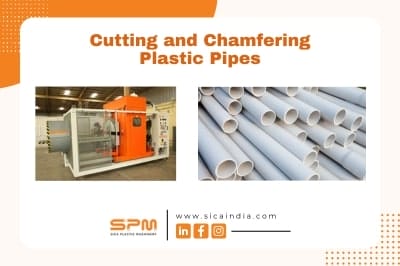
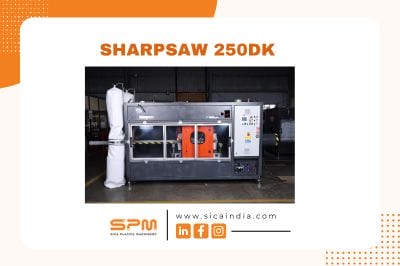
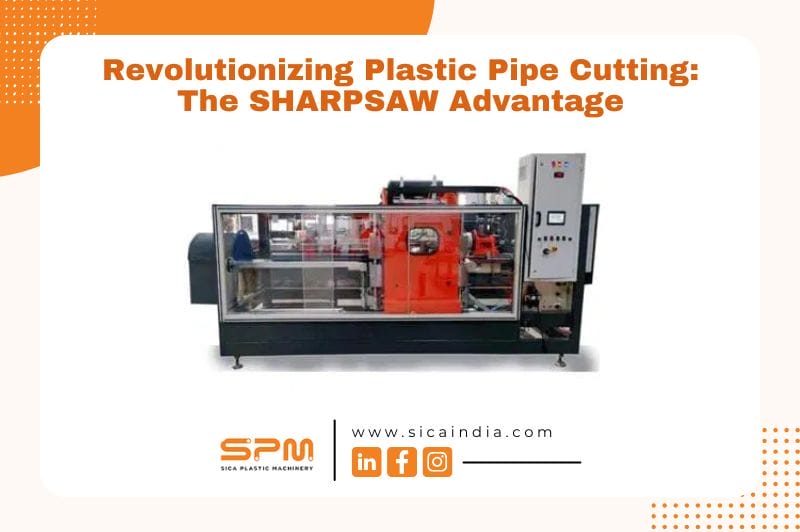
This is where corrugated lines most often go wrong. A rotating disc cutter removes material as swarf, and on a corrugated profile that swarf ends up inside the pipe. The SHARPSAW cutting and chamfering machine addresses this with knife (K) cutting tools optimised for corrugated profiles, delivering burr-free cuts without crushing or deforming the corrugations.
The distinction between SHARPSAW tool configurations is worth understanding before you specify:
| Series | Cutting principle | Suited to | Debris behaviour |
| K series | Planetary knife system | Rigid PE and PP pipe, including corrugated profiles | Swarfless — no chips or scrap produced |
| D series | Planetary disc rotary system with feeler pin | PVC and PP plain pipe, thick wall, out-of-round | Chip extraction and dust collection system fitted |
| DK series | Combined disc/milling arm plus knife arm | Rigid PVC, PE and PP | Disc cuts to depth, knife completes through remaining wall — no chips inside the pipe |
For corrugated work the K series is the natural fit: it cuts through the profile without producing chips at all, which removes the internal-cleanliness problem at source rather than managing it afterwards. SHARPSAW cutting machines cover pipe from OD 10 mm to OD 630 mm across the range. A fuller treatment of cutting technologies sits in our guide to the four fundamental types of plastic pipe cutting machines, and the SHARPSAW DK saw range is covered separately.
A practical note on cut position. On corrugated pipe the cut plane is not arbitrary. Cutting through a rib crown leaves a fragile, partly-open annulus at the pipe end; cutting in the valley gives a clean, closed face that seats properly in a coupler. Registration of the cutting carriage to the corrugation pitch is therefore part of the commissioning conversation, not an afterthought.
Socketing and Joint Ends on Corrugated Pipe
Not every corrugated pipe is socketed. Much of the Indian market ships plain-ended corrugated pipe joined with external couplers, and for those lines the downstream ends at cutting and handling. Where an integral socket is specified, the belling stage introduces the same requirements it does on plain pipe: uniform heating of the pipe end, a socket perpendicular to the pipe axis, and a bore dimension held tightly enough for the seal to work.
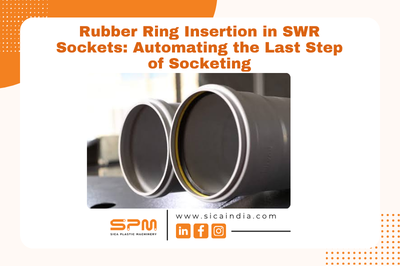
The FASTFORM automatic inline belling machine forms solvent cement, SWR and O-ring pressure (elastomeric) sockets using dual-oven heating and, on the larger models, a mechanical collapsible mandrel that allows socket forming with zero pipe wastage. If your corrugated pipe requires a socketed end, confirm the socket profile and pipe construction with SICA India engineering before specifying a belling stage – socketing behaviour on a hollow corrugated section differs materially from socketing a solid plain wall.
Background on socket geometry and the differences between joint types is set out in types of sockets in plastic pipes.
Handling, Collection and Palletizing for Corrugated Pipe
Corrugated pipe is bulky, light for its volume, and easy to deform under point loads — which makes handling a genuine engineering stage rather than a conveyor afterthought.
SICA India Link Channels are belt channels of 3.0 m or 6.0 m length that move pipe from OD 32 mm to OD 250 mm off the line and unload it sideways onto a palletizer or downstream station, with belt speed adjustable via inverter. Both LINK 250 models are specified for agricultural, SWR and corrugated pipe, at 0.74 kW for the 3 m unit and 1.9 kW for the 6 m unit.
Where corrugated pipe feeds a socketing station from twin lines, the AUTOFEED collection table collects cut pipe and presents it to the belling machine one pipe at a time, which prevents the pipe-on-pipe stacking loads that cause profile flattening in manual buffers. Downstream of that, pipe palletizing and stacking equipment completes the line.
Single-Wall and Double-Wall: What Changes Downstream
SICA India downstream machines are designed to process both single-wall and double-wall corrugated profiles, but the two constructions load the downstream differently.
| Factor | Single-wall corrugated | Double-wall corrugated (DWC) |
| Construction | Fully corrugated wall, inside and out | Corrugated outer wall bonded to a smooth inner wall |
| Typical use | Cable ducting, subsoil and agricultural drainage | Underground drainage and sewerage, stormwater |
| Flexibility | High — often coiled in smaller diameters | Low — supplied in straight lengths |
| Haul-off concern | Ovalisation of a thin flexible section | Crown crushing that reduces ring stiffness |
| Cutting concern | Clean valley cut on a thin wall | Cutting two walls plus the hollow annulus in one pass |
| End-of-line | Coiling or light bundling | Straight-length bundling, strapping and palletizing |
What Is Driving Corrugated Pipe Demand in India
Four application segments account for most corrugated capacity being added in the Indian market, and each one sets a different downstream priority.
- Underground drainage and sewerage. Double-wall corrugated HDPE and PP pipes are preferred here for their high ring stiffness, chemical resistance and long service life. Downstream priority: profile integrity through haul-off.
- Cable protection. Single-wall and double-wall corrugated pipes protect electrical and telecommunications cables in underground ducting. Downstream priority: internal cleanliness – a chip in the bore is a cable-pulling failure.
- Agricultural drainage. Perforated corrugated pipe manages water tables and prevents waterlogging. Downstream priority: gentle handling of a light, flexible section.
- Stormwater management. Large-diameter corrugated pipe forms the backbone of urban and rural stormwater infrastructure. Downstream priority: haul-off pulling force and cutting capacity at the top of the diameter range.
If you are also running HDPE plain pipe alongside corrugated, the complete HDPE pipe extrusion line downstream guide covers that line stage by stage. The full machine range is on the SICA India products page.
Frequently Asked Questions
Does SICA India manufacture corrugators?
No. SICA India specialises in downstream equipment — haul-off, cutting, chamfering, socketing and pipe handling. The machines integrate with any corrugator brand and do not require replacement of upstream equipment.
What corrugated pipe sizes can the equipment handle?
SHARPSAW cutting machines handle pipe from OD 10 mm to OD 630 mm. POWERPULL haul-off units cover OD 10 mm to OD 630 mm across six models. Link Channels move pipe from OD 32 mm to OD 250 mm.
Can the same machines run both single-wall and double-wall corrugated pipe?
Yes. SICA India downstream machines are designed to process both single-wall and double-wall corrugated profiles. Tooling and grip settings are configured per profile.
Why is a knife cutter preferred over a disc cutter for corrugated pipe?
A disc cutter removes material as swarf, and on a corrugated bore that debris lodges in the valleys and cannot be flushed out. A planetary knife system cuts without producing chips or scrap, so the internal-cleanliness problem never arises.
Can this equipment be added to an existing corrugated line?
Yes. SICA India downstream equipment is designed for integration with any make of corrugator and extrusion line, and is commonly retrofitted to lines already in production.
Specify your corrugated downstream line. Send your pipe range, construction type and target line speed to SICA India and the engineering team will size the haul-off, cutting and handling stages against it — contact SICA India.